Working as an Associational Party
The WFP not only shows that it is possible to build an associational party by investing in an organization but also offers a picture of what it means to work as a party. This section explores how the WFP systematically delivers a variety of essential party functions identified in the literature and how its capacity to perform them is enhanced by its associational qualities. The WFP supports its candidates with electioneering expertise and technical assistance and provides its members with informal access to elected officials, all while facilitating a delicate two-way street of communication among its leaders, candidates, members, and voters. Indeed, the WFP offers a contemporary illustration of a strong associational party.
Recruiting and Cultivating Candidates from the Party’s Constituencies
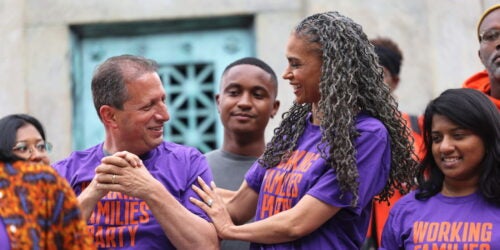
Despite its strategy of only rarely running stand-alone candidates, the WFP sees candidate recruitment as a central task—a task it has undertaken in both formal and informal ways. Brad Lander, who “identifie[s] as a Working Families-Democrat,” won several races for the New York City Council before winning citywide for comptroller.1 His entry into politics serves as an example of how the WFP, as an associational party embedded in the local community and committed to a face-to-face form of politics, is able to inspire and support candidates who might not otherwise run.2
Lander has publicly stated, “I never would have been interested in running but for the party.”3 As director of the Fifth Avenue Committee, Lander was not infrequently asked whether he was interested in running for office. He remembers responding, “Oh, gross. Like electoral politics is not a space that I would think of as being a place I would want to be.” But that attitude changed. Lander explained in an interview with the author that his decision to run for office emerged from his work with the WFP: “It was through working with WFP that it became—that electoral politics became—more compelling to me.”
The WFP provided key technical support as Lander entered the race. At the time, Lander said, “I was both embedded in its coalitional structure through my organizational housing and progressive planning work and…as a member of South Brooklyn WFP.” He recalls turning to his associates at the WFP and saying, “You know, I’m only doing this if you guys are with me.” WFP leadership responded with critical, concrete advice about becoming a viable candidate, including “the [funding] targets you have to hit and all the people you have to talk to.” Lander recalls a key moment: “I remember Bill [Lipton], like, they sent me an original target of, like, you have to raise $35,000 by the next filing deadline. And I remember then Bill called one day and said, ‘Brad, I’m sorry to do this to you. But I see that Josh Scaller is out there, and I bet he’s going to do that. You have to up your number and raise more than 50[,000].’ And I was like, ‘Bill, I can’t do it. I’m already killing myself at 35[,000].’ And he’s like, ‘No, you have to go do it.’”
Lander raised $51,000, only to learn “Josh Scaller filed with $35[,000]. And, like, had I filed with $35[,000], I would not have been the front-runner.” Once nominated, WFP staff also trained Lander “on door-knocking.” Lander’s experience, while not typical, was also not “unique.” Indeed, Micah Sifry’s account of the WFP in its early years suggests that, for at least some party members, cultivating politicians who identified as WFP members was a central ambition.4
The WFP also invested in formal candidate recruitment processes.5 In 2007, in collaboration with its institutional members SEIU Local 32BJ, Make the Road New York, the Hotel Trades Council, and New York Communities for Change, the WFP funded the Pipeline Project.6 In a 2014 interview, Lipton, the party’s deputy director at the time, explained that the project aimed to identify, train, and run candidates for local offices across the state, focusing on town councils and school boards. The aim was to identify about 1,000 prospective candidates in off-cycle years in order to select about 75 to run; the party hoped this would ultimately mean six to eight candidates would be elected to the state legislature during each election cycle.7 Candidates were intensively vetted and advised about the fundraising targets necessary to demonstrate electoral viability.8 While successful in New York City, the effort did not ultimately produce the anticipated pipeline of statewide candidates and was abandoned.
The WFP’s “homegrown” candidates maintain closer ties to the party. Cultivating and selecting candidates results in a different level of party commitment. As Jasmine Gripper, the current co-director of the New York Working Families Party, explains, “When people come from the party or from our affiliates or our friends, the relationship they have with the party and to progressive issues, they tend to be stronger, especially in those moments of challenge.”9 The homegrown relationship to the party can emerge not just through recruitment but also when the WFP plays an essential role in getting someone reelected during a hard race.10 The WFP does not formally recognize its special relationship with a candidate—such as by providing them with the equivalent of an automatic invitation to its party convention or some other equivalent to a “superdelegate” vote—but these are the candidates to whom the party turns every two years when it needs to meet its threshold level of support to maintain its ballot line.11
As an associational party committed to representing a multiracial coalition of working- and middle-class voters, the WFP has understood the importance of cultivating, training, and supporting a pipeline of candidates from its political networks through both formal and informal strategies. Even as it has eschewed running stand-alone candidates in New York for fear of spoiling, the WFP contributed to reshaping the pool of candidates and elected officials in New York.12
A major political party committed to an associational rebuild could easily replicate this process. Indeed, in 2018 and since, the Democratic Party has invested in candidates with ordinary middle-class backgrounds—nurses, teachers, and waitresses—and military veterans.13 Today, many of these officials hold important positions within the national party and as state governors.14
Providing Legislative Access for Members
The WFP’s investment in candidates does not end on Election Day. The party supports newly elected officials with staffing, institutional knowledge, and coordination with other WFP-aligned officeholders—importantly extending its support to the legislative work of those it has brought into office. The WFP thus facilitates homegrown officeholders’ access to legislative powerbrokers but also imposes discipline on its elected officials. Once in office, WFP candidates are expected to prioritize the party’s agenda.
In New York City, WFP’s legislative support has facilitated the formation of a dues-paying Progressive Caucus and the development of shared policy priorities. With its guidance, members of the Progressive Caucus in 2009 (the year Lander and several other WFP-recruited or nominated candidates were elected to the New York City Council) settled, for example, on three legislative priorities, which it has since more or less achieved.15 In Albany, there is no formal structure for the party’s legislative support. Nevertheless, the presence of a cohort of elected officials with strong ties to the WFP and the party’s legislative support communicates to state and local powerbrokers that the party (and its progressive agenda) is a stable force in New York politics. Democrats and Republicans have come to recognize these are not just one-off individual officeholders with rogue progressive dreams, elected based on their charisma. As a former New York WFP director puts it, “It’s not just a one-to-one matchup”; these officials are a coalition, a party, that “also will govern together in some kind of way.”16 And the WFP makes sure it does, even when it involves reminding officials what they agreed to when they accepted the party’s nomination.17
More unusually in contemporary American politics, the WFP also provides its members—the party faithful—with enhanced access to the legislature. WFP membership facilitated constituent services. Elected officials would pick up the phone when community leaders called, providing the level of access that donors currently expect. But party membership also provided more significant access.
Through their affiliation with an associational party with rich social networks, members and local chapters had access to elected officials in ways that are typically only afforded to wealthy donors.
Through their affiliation with an associational party with rich social networks, members and local chapters had access to elected officials in ways that are typically only afforded to wealthy donors.18 Lewis explains that ACORN and Citizen Action, for example, quickly learned that they could “enlist…labor brothers and sisters as allies to help you, you know, to get, you know, to so-and-so or to make an introduction or to the elected official.” The unions’ members, given their long-standing ties to Albany, provided the grease in the political wheels for grassroots membership associations and their individual members.19
One interviewee, a local party leader, described how this played out for the South Brooklyn chapter. Concerned about fracking, the South Brooklyn chapter, under a proactive leader, decided between election cycles to initiate a campaign to ban fracking. The group set about “to make appointments with any assembly member or senator who would meet with us.”20 “I would call up and say, ‘Well, we want to talk about issues that WFP is going to be doing this year in the legislature.’” Much to the chapter’s surprise, the officials agreed: “They were all shocked that there was any group that wanted to meet with them about these statewide issues because they only got lobbied by people with a financial interest or with a local interest.” Once in the room, the group was able to convince its state representatives that fracking was not simply “an upstate issue,” reminding the Brooklyn contingent that they constituted 20 percent of the Democratic caucus in the state legislature. The interviewee admits, “I can’t believe that this actually worked…the 20 Brooklyn assembly members, broadly enough, took up the cause of fracking” because “it didn’t cost anybody anything…They [got] a ban that year.”
Holding the Coalition Together
A broad and diverse party coalition comes with challenges. Those challenges are exacerbated when the axes of divisions fall along the usual American fractures: class, race, and language. Political parties, especially new ones, must diversify their coalition to achieve support at a scale capable of exercising political power, but this in turn creates the challenge of how the party can maintain the coalition over time. Even within a left-leaning party with strong ideological coherence, bringing together working-class voters (unionized and unorganized) and wealthier liberals created challenges. Add to that race and the intraparty dynamics became even thornier. As Lewis acknowledges, “There was always tension between the groups that made up the WFP.”21
The challenges of holding together a racially and socioeconomically diverse coalition were immediately manifest when it came to organizing. At the organizing level, the party quickly learned that ACORN’s model of grassroots organizing did not transfer well to party organizing. Party organizing depends on building bridges “against the grain,” connecting communities that feel distant from one another and may even see themselves as divided from one another.22 The ACORN model, by contrast, was predicated on organizing in “a community of like people with shared things in common,” often at “the landlord level,” as one party staffer explained.23 The ACORN model was not designed to “bring in people with different racial backgrounds, class backgrounds, and everything, and just, like, you know, make it happen”; “[When] you have a shared landlord, [there’s a] good chance you got a shared ethnic background, too.” A county like Westchester, however, is a totally different ballgame. It is significantly more racially diverse than one might assume. The party adjusted. Its vote share has grown significantly since the early years even as it has maintained and expanded the diversity of its coalition.
Tensions associated with the diversity of the coalition could also emerge during the candidate selection processes. Scharff acknowledges that while the selection process was “a very empowering process for the members who don’t have that access normally,” it was also run by party members, who did not necessarily expect the “very diverse room” in which it would often happen. She recalls, “Sometimes it’s like you have a union member in with a bunch of lefty activists and with a bunch of Citizen Action, you know, older Black members…and [it’s] not easy sometimes to sort that all out, because it creates different opinions about candidates and also different opinions about what’s appropriate to ask and so on.”
When Make the Road New York, a largely Spanish-speaking dues-paying membership organization that works for and with immigrants, joined the party, a new axis of diversity—language diversity—was added to the mix. Local chapters, at the time, took for granted that their nomination meetings would be conducted in English. WFP staff and leadership strategized about how to integrate non-English-speaking members into the process, Scharff said. Like most organizations, “the party has had periods of being really good about figuring out how to create the right setting for those things to work well and periods of being really bad at it, where there have been endorsement interviews that have exploded in charges of racism and people walking out of the room, and, like, bad things have happened because it’s not managed.” Despite these moments, the WFP has not just maintained but expanded its geographically, racially, and socioeconomically diverse coalition.
The WFP’s capacity to mediate the different priorities, preferences, interests, and needs of its multiracial coalition was a product of party culture reinforced by the political power derived from the ballot line. From the start, party leadership viewed the internal axes of division as a source of political strength and worked hard to create a culture where differences did not lead to exit. Master emphasizes, “We tried to create a culture in which people understood they weren’t going to win every debate over who to endorse or not.” The result was that people were willing to tolerate their differences, even lose some battles, knowing that down the line they would get their turn. Mitchell, the current director of the national party, goes further, insisting that intraparty conflict, if properly organized and mediated by party staff, can be “generative” in ways that furthers the party’s ongoing core commitments. So long as “the activists,…the labor institutions, and [the] grassroots organizations…believe the table is strong and fair,” he says, the coalition will hold together. The WFP seeks to inculcate a belief “that the [party] vehicle, ultimately…is more important than the individual decision.”
The ballot line critically reinforced this culture by creating significant incentives for the coalition members to stay put as they built and rode the WFP’s train to power. As one staffer explained, “When you have a ballot line, it makes it more likely that people stick together and allows you to build durable power in the long term because you have something of value.”24 This shared motivation compensated for the escalation of conflict that came with an expanded coalition. Lipton shared that, “We sometimes would say the line provides the glue.”25 The strength of the glue—its capacity to keep the coalition together—was entwined with the political power the party holds.
The ballot line insulated the coalition from fracturing over any individual nomination or policy fight because members saw how it drove tangible political returns to party membership. As one staffer with firsthand experience navigating such moments explained, power was key to holding the coalition through tough fights, continuing, “if you have that power, you can achieve that power in a coalition without a ballot line,” but it is much harder to amass the necessary political power without the ballot line.26 Another explained, “The line…creates a level of permanence to the coalition. There is this thing that exists in the law. It exists because you have 50,000 voters.”27
While the scaling power of the ballot line is specific to a new party, the ballot line serves as glue for all parties. How else does one explain the unity of the Republican Party today? This organizational advantage is why Didi Kuo and I have argued that “outsourcing our political organizations to non-party groups is not a solution…Grassroots and civic organizations struggle to perform the twin tasks of maintaining political energy on the ground and scaling up to be effective statewide or at the federal level.”28 They are generally less likely to be socioeconomically or racially integrated or to reflect the diversity of a jurisdiction. And they are also more fragile because coalitions are also not necessarily well-situated to mediate conflict when it arises, as it inevitably will. The ballot line, by contrast, is a source of power that draws people to it and keeps them there, as the WFP story shows. Without the ballot line, coalitions do not have external pressures holding them together.
Party glue can, of course, fail. In 2018, several of the party’s founding union members did leave the party. But, as Scharff astutely observes, “the biggest departures weren’t over internal fights. It was over Cuomo dividing us on purpose.”29 Even this conflict, however, reveals the power of the ballot. After he had successfully orchestrated the departure of several key unions and their money from the WFP, Governor Cuomo’s immediate next move was to attack the WFP’s ballot line. In 2020, Cuomo led a charge to change ballot access laws to make it significantly more cumbersome and expensive for minor parties to maintain their ballot lines.30 Minor parties in New York would now be required to demonstrate their electoral support biannually (rather than every four years) and to achieve a larger vote share to maintain ballot access.31 Although Cuomo’s aim was to further cripple the WFP, through its ballot line, it had institutionalized enough power by that point that it was able to withstand Cuomo’s assault. Indeed, some argue that Cuomo’s attack backfired by “galvaniz[ing] grassroots energy and participation to the point where, like, you know, if you look at the ballot line numbers in 2020, they were astronomical.”32 Indeed, what is clear is that while the party’s power, like its priorities, has changed, the WFP has stood firm. So firm that, as we have seen, the party was critical to Cuomo’s defeat in 2025, and the mayor who defeated him—a DSA-Democrat—voted on its line.
Citations
- Brad Lander Aff. ¶ 1, ¶ 3 In re Malinowski App. II (“I have served as the New York City Comptroller since January 1, 2022” after serving “three terms on the New York City Council, representing the 39th District”).
- Abu El-Haj suggests that an associational party that cultivated participation by the party faithful might in turn lead those individuals to run for office, breeding a different, more representative cadre of candidates. Abu El-Haj, “Networking the Party,” 1270, source.
- Meyerson, “Meet the Working Families Party,” source.
- Sifry quoted Bertha Lewis as suggesting her goal was “to grow folks for real, outside of the Democratic machinery,” dreaming of “a pure, unadulterated, born-and-bred WFP-er.” Sifry, Spoiling for a Fight, 268.
- Abu El-Haj and Kuo, “Associational Party-Building,” 158–159, source.
- Democracy Alliance Memo Appendix C, 20 (on file with the author) noted that in the initial phase “eight progressive champions were elected, all in races either against establishment Democrats or incumbents.”
- Meyerson, “Meet the Working Families Party,” source.
- Democracy Alliance Memo, Appendix C, 20: “Candidates were then put through an intensive vetting process to ensure that they shared Working Families values and that they were capable of running successful campaigns. Candidates in targeted races filled out monthly reports and were asked to meet basic fundraising and organizing thresholds to continue being top-tier candidates.”
- Related, from Scharff’s interview with the author: “So we definitely have candidates who feel that, you know, regardless of the fact that they’re a registered Democrat in their state, they feel that they’re part of the WFP and the WFP is their party”; and from Cohen’s interview: “Like when the WFP really throws down and has some like elected people. Particularly like when it’s the race that sort of makes somebody, right? That, like, brings somebody into office. I think there is a different kind of relationship there of just, like, we’ve been…in it from the beginning, right? Together, like, and…there’s just a shared and affinity there.”
- Aaron Cohen (formerly of Make the Road Action), interview with the author, December 15, 2023.
- Brad Lander (endorsee and member, Working Families Party, Comptroller, City of New York, Member, New York City Council from the 39th District), interview with the author, December 15, 2023.
- Pocasangre and Strano suggest that fusion minor parties offer opportunities to reshape the supply of candidates by inspiring candidates to run for office as part of an assessment of fusion as a political strategy for a moderate party. Pocasangre and Strano, What We Know About Fusion Voting, source.
- Abu El-Haj, “The Possibilities for Responsive Party Government,” 123, source; Abu El-Haj and Kuo, “Associational Party-Building,” 151–165, source; see also Nicholas Carnes, White-Collar Government: The Hidden Role of Class in Economic Policy Making (University of Chicago Press, 2013).
- Tabatha Abu El-Haj, “The Impact of Associational Party Building on the Democratic Party,” Election Law Blog, December 16, 2025, source.
- Its first three priorities were paid sick days, higher wages for city-funded projects, and inclusionary zoning. Two of the three were achieved during Bill De Blasio’s tenure as mayor. City-funded projects also are now required to pay higher wages, but that push took longer and involved the state.
- Sochie Nnaemeka (former New York State Director, Working Families Party), interview with the author, January 18, 2024.
- Party discipline is a basic function of political parties. It is, however, particularly challenging for a fusion party given that, as Lander himself notes, for every voter on the WFP line, there are likely at least five times more votes on a major party line. The fact that the WFP has managed to enforce such discipline speaks to its success as a functioning political party.
- See Joshua L. Kalla and David E. Broockman, “Campaign Contributions Facilitate Access to Congressional Officials: A Randomized Field Experiment,” American Journal of Political Science 60, no. 3 (2015): 545, source.
- Some readers might wonder what the unions got out of being a part of the party. Cantor explains that one key return for the unions was when they needed bodies in Albany, the community organizations reciprocated: “We’d show up at union events or a picket line,” and “they’d be ecstatic. Twenty nonworkers showing up to say, ‘We’re standing here in solidarity.’”
- Dorothy Siegel (former Brooklyn Chair and current Treasurer, New York Working Families Party), interview with the author, January 11, 2024.
- Another axis of division, especially within the leadership, was gender. Lewis, for example, shared, “There were gender tensions—between the women in the party and the men in the party. It didn’t matter whether the men were organized labor or the men were associated with community organizations. It just, you know…And even though women were doing most of the fucking work.”
- Zack Fletcher (Field Director, New York Working Families Party), interview with the author, January 26, 2024.
- Zack Fletcher (Field Director, New York Working Families Party), interview with the author, January 26, 2024.
- Zack Fletcher (Field Director, New York Working Families Party), interview with the author, January 26, 2024.
- See also Scharff, interview: “Because of the ballot, people are more likely to stay and not leave over disagreements because you want to have power over the ballot line. So the ballot line was a very important glue that kept us in across disagreements when there were some hard decisions. Like everybody had an experience of losing on something that was important to them and didn’t leave.”
- Zack Fletcher (Field Director, New York Working Families Party), interview with the author, January 26, 2024.
- Leah Hart (formerly of SEIU Local 32BJ), interview with the author, January 24, 2024.
- Abu El-Haj and Kuo, “Associational Party-Building,” 132, source.
- The first signs of trouble for the WFP in its struggles with Cuomo began in 2014. See Sally Goldenberg, “Working Families Party Loses Another Constituent Union,” Politico, April 25, 2016, source.
- In 2024, for example, when New York had over 8 million votes in the presidential race, a party would have to secure more than 167,000 votes on its ballot line, whereas in 2019 a party would only have had to clear 50,000 votes in the gubernatorial race to retain party status. See New York Election Law § 1-104 (McKinney). Both the Green Party and Libertarian Party lost ballot access after this change. The new law also increased the number of petition signatures to get on the ballot—for statewide office that is now the lesser of 15,000 or 5 percent of a party’s enrolled voters. This was substantially reduced during the years of the coronavirus pandemic to just 1.5 percent of enrolled voters, a provision which has expired. See New York Election Law § 6-136 (McKinney).
- “Previously, in order to gain an automatic ballot line, a political party had to have its nominee for governor receive 50,000 votes each four-year cycle. The new law significantly increased that requirement to 2% of votes or 130,000, whichever is greater, every two years, in gubernatorial and presidential elections.” Samar Khurshid, “New York’s Smaller Political Parties Must Quickly Meet New Ballot Thresholds,” Gotham Gazette, April 13, 2020, source.
- As Aaron Cohen (formerly of Make the Road Action) further explained in an interview with the author, December 15, 2023: “A silver lining of some institutions moving out or stepping away at least for a time” has been “an opportunity for some of the grassroots partners like us who have taken on greater primacy within the party coalition.” See also, interview with Scharff: “We survived it. It actually was honestly good for us in some ways. That forced us to get more votes on the line, which we were not that focused on at the time because we had got to [the] point where getting 50,000 votes every four years was easy.” Over 386,000 votes were cast on the WFP line for Joe Biden in 2020. The WFP secured more than 277,000 votes in the 2024 presidential election. See New York State Board of Elections, “2020 Elections General. Election Results,” source; New York State Board of Elections, “11-05-2024 General Results by County-Judicial District-Congressional District-State Senate District-Assembly District,” source.