Introduction
Americans want the federal government to address their needs, but the Democratic and the Republican parties continue to prove themselves unrepresentative, unresponsive, and unable to solve societal problems. Congress has become a clubhouse for millionaires, distant and removed from the lives and struggles of ordinary Americans. The Anti-Federalists’ fear that the federal Constitution would create a distant government, only weakly accountable to the people that would have enormous discretion to make law and policy, has materialized, and public trust in democracy is at an all-time low.1
The two major parties are largely to blame. As Lee Drutman has said, “Political parties are the infrastructure of modern mass democracy.” Just as roads and bridges are necessary for “a thriving economy,” political parties are essential for representation: They “connect citizens to the government” and “[improve] the collective welfare” of everyone.2 The Democratic and Republican parties are, unfortunately, roads after a long icy winter, full of potholes. In 2024, both parties initially nominated aged and highly unpopular presidential candidates. The previous year, the House of Representatives sat leaderless for a full three weeks during a major international crisis. Congress’s legislative track record is decidedly weak, and it has been unable to address the basic needs of most Americans, including housing, education, and affordable groceries. The provision of affordable health care is illustrative. In 2025, 58 percent of voters expressed a desire for Congress to extend the Affordable Care Act’s subsidies to ensure that Americans with marketplace insurance would not see a dramatic spike in their premium costs. Yet the U.S. Senate sat paralyzed when budget negotiations closed, with Republicans unable to form a majority around any alternative to the subsidies they still refuse to extend.
With both political parties unable to fulfill the basic functions of party institutions—representation, responsiveness, and governance—parties are losing the public’s faith.3 This dim view of the two major political parties is shared across racial groups.
Americans are reacting to their disillusionment with the two major parties by shedding their partisan affiliations and registering as independents.4 In numerous states—Alaska, Arizona, Arkansas, Colorado, Connecticut, Hawaii, Indiana, Maine, Massachusetts, Michigan, Mississippi, Nevada, New Hampshire, North Carolina, Ohio, Oregon, Rhode Island, and Tennessee—independents now outnumber partisans on the voter rolls. The trend is starkest among voters under 25: Only half are willing to affiliate with either of the major parties. Even among Black voters, who historically evidence strong alignment with the Democratic Party, there has been an uptick in the number who now identify as independent or unaffiliated.
While the instinct to eschew political parties is understandable, the responsiveness Americans crave is not possible without political parties and the sustained political organization only parties can provide.5 In their absence, even high voter turnout is unlikely to translate on a sustained basis to policy responsiveness or political accountability.
Efforts to address contemporary democratic dysfunction thus hinge on restoring the functionality of our political parties—not on redirecting politics outside the party system. It requires understanding why today’s party system is failing to deliver for Americans. One significant factor is the increasing hollowing out of political parties. Parties have ceased prioritizing ties to communities, building communities of voters with shared ideas, and delivering responsive governance; instead, they increasingly function as fundraising operations and short-term campaign machines, oriented toward mobilizing for elections.
Political parties, like many of our civic associations, transformed in the mid-twentieth century. Where parties once operated as mass-membership organizations with a significant local presence, they now resemble major corporations channeling money, more and less transparently, through subsidiaries, affiliates, and partners (state parties, PACs, and 501(c)(4)s). Today, parties see themselves as primarily marketing a brand developed by paid consultants and pollsters in a national market in which voters are consumers. Parties are equally disconnected from their candidates. Rather than cultivating and promoting candidates, parties today often compete with upstart, outside candidates, many of whom operate their own (albeit short-lived) political machine. (Barack Obama and his advocacy group, Organizing for America, is a case in point.)
This institutional reconfiguration has come with concomitant substantive changes. As the two major political parties embraced their role as heuristic brands and vehicles for funding elections, they significantly divested in state and local parties, becoming more exclusive, elite, electoral organizations in the process.6 This hollowing out of our political parties has also had considerable consequences on the tenor of our politics and contributed to their inability to solve problems, including developing a cohesive policy program that is responsive to the public.7 Finally, the new configuration offers few tangible ways for ordinary voters to engage with the political parties, leaving many with little faith that their political engagement makes a meaningful difference in politics. Indeed, with this transformation, political parties have largely abdicated any role in conferring actual benefits to supporters, socializing them into democratic politics, or nurturing commitments to democracy.8
While many argue that party reform should focus on shoring up party leaders and their control over both nomination and campaign funds,9 Didi Kuo and I have focused on strategies that enhance the capacity of political parties to deliver for their constituents.10 Restoring public confidence in democracy, we have argued, requires strengthening political parties as organizations and strengthening their ongoing connections to voters. The path to a better politics requires “associational party-building”—an approach to party reform that focuses on investing in local parties that function with ongoing, year-round, face-to-face connections to citizens and local groups rather than shoring up the power of party leaders by enhancing their financial muscle.
Nineteenth-century American parties offer a proof of concept for the kinds of parties to which we should strive and point to the importance of state and local party organization. Corrupt, hierarchical, and exclusionary, nineteenth-century political parties were flawed. They certainly did not mobilize all people equally. Nevertheless, like the card-carrying membership parties of Western Europe, they demonstrate how local party organizations served as mechanisms for grounding party elites, particularly national elites, in the preferences and needs of their constituents. Nineteenth-century parties also show how strong state and local parties—parties housed in local clubs that sponsored Fourth of July parades and handed out jobs—offered a meaningful form of association for members while developing a pipeline of homegrown party leaders and candidates with authentic connections to their communities, allowing American political parties to serve their vital intermediary function and to “link citizens and civic groups to their government.”11
Associational party-building is part of a growing literature refocusing political science on the importance of party presence at the state and local level.12 Its distinct contribution as a reform strategy is its underlying theory: A political party with social breadth and interpersonal depth in the form of face-to-face engagement with voters, including through civic intermediaries, will ground elected officials in the experiences of their constituents. One challenge this new literature has drawn is the concern that it is naïve, nostalgic for a kind of face-to-face politics that is just not possible in an age when politics is dominated by social media and AI bots rather than party clubs and bosses.13 Prior articles, in fact, have outlined examples across the country (most prominently in Texas, Nevada, Georgia, and Florida) of state and local Democrats and Republicans engaging in the associational party-building we prescribed—and outlined how those nascent tendencies could be reinforced and expanded.14
Nevertheless, skepticism has reasonably remained as to whether any of what we suggested is possible. Is it possible to either rebuild the parties we have or build new parties as associational parties capable of providing representation and delivering for the American public? Is it possible to build political parties Americans can believe in? Parties capable of providing representation, of governing in ways that make life better, and of remaining accountable? Parties worthy of public trust in (party) government?
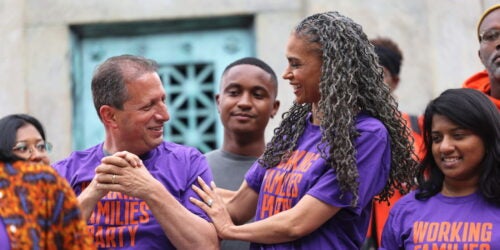
This report uses the experiences of the Working Families Party (WFP) in New York to demonstrate that associational party-building is not just possible but has happened.15 It describes how the WFP used fusion voting to build a meaningful associational third party in New York and analyzes how its choices offer a blueprint for associational party-building for the major American parties, as well as for existing or new minor parties.
The WFP story begins in 1998. Building on the work of Dan Cantor, a longtime political organizer with roots in ACORN, and Joel Rogers, a professor of law and sociology at the University of Wisconsin,16 leaders at a handful of midsize unions and grassroots membership-based civic groups in New York set about to establish a new political party. Formally speaking, what they established was a political association, created with the purpose of eventually becoming a ballot-qualified minor party. New York was chosen for the idiosyncrasies of its fusion election laws, which permit parties to intermittently join forces and cross-nominate a single (typically major party) candidate for office. The availability of so-called fusion voting in New York significantly mitigated the obstacles to forming a viable third party in an electoral system like ours, which combines single-member districts with first-past-the-post vote count rules.17
Today, the WFP exists not just as a political brand on the ballot line but as a party organization with deep ties to civil society and the New York electorate.18 By 2018, it operated as an engine of organization for left-of-center politics in New York. By the early 2000s, the party’s electoral power grew sufficient for it to begin delivering for the working-class voters and voters of color, who had been left behind by the Democratic Party’s embrace of significant elements of Ronald Reagan’s neoliberal economic policy and rejection of the social safety net. The party was a key driver of the repeal of the Rockefeller Drug Laws, New York’s adoption of paid sick leave, and a significant tax increase on wealthy New Yorkers. As one WFP party leader brags, “There was like, you know, a 13-year period where we were…the most powerful organization in New York politics.”19
Whatever the exact truth of that statement, there is little question that the WFP became and remains a key party player in New York politics. On November 4, 2025, Zohran Mamdani made a point of telling reporters that he had voted for himself on the WFP line. A few months earlier, the City Journal ran an article blaming his upstart victory in the Democratic Party on the WFP, which it disparaged as “the New Boss of New York Politics.” What is most surprising about all of this is that Mamdani’s roots are not in the WFP; indeed, the WFP’s old guard view him, correctly, as a Democratic Socialists of America (DSA) prodigy.
This report offers an analysis of what it takes to build the kind of political power that led a DSA Democrat to vote on the WFP line and his rivals to accuse the party of being “the modern equivalent of Boss Tweed”—the most powerful and infamous leader of the city’s nineteenth-century party machine. It details how, over 25 years, the WFP has built and defined a strong brand with significant electoral appeal—the prevailing measure of party strength in political science—and “created a pool of people” for whom casting a vote on the WFP line is a way to signal their values, a “way of saying ‘I’m a liberal,’ you know? ‘I’m a social democrat. I’m for economic justice. I’m for racial justice.’”20
At first glance, the WFP may not fit the conventional view of a political party. It rarely runs its own candidates, does not prioritize voter registration under its own label, and often exerts influence through Democratic primaries rather than general elections. These features have led some observers to dismiss the WFP as a mere faction or a strategic pressure group rather than a party in its own right.
This report rejects that view. The WFP exemplifies a form of party organization that differs sharply from the dominant “party blob” model that characterizes contemporary American politics. It is a party with a clear brand. The clarity of its brand surely is one reason why Mamdani voted on the WFP line. But the WFP’s orientation to party formation also pushed “beyond a view of parties as vehicles for funding elections, policy-demanders, or heuristic brands.”21 As Karen Scharff, a co-founder and party co-chair, recalls, “Forming a new party took an immense amount of work. Hundreds of house meetings, massive volunteer recruitment. Thousands of signatures gathered. Presentation after presentation to civic groups about the value of voting for a new party.”22 The WFP’s story is much more than a story of a party as an ideological messenger or a story of strong party leadership.23
Rather than functioning primarily as a brand, a fundraising vehicle, or a loose network of candidates, the WFP operates as an associational party.
Rather than functioning primarily as a brand, a fundraising vehicle, or a loose network of candidates, the WFP operates as an associational party: a durable organization embedded in civil society that recruits candidates, coordinates governing action, mediates conflict within a diverse coalition, and translates electoral support into policy influence. It has significantly invested in building a party organization and an embodied face-to-face party coalition (a party association)—with all the accompanying struggles of holding its membership and coalition together. As such, the WFP story illustrates the mechanics of associational party-building and its potential as a party reform strategy. It explains why, within just a few years, powerful unions started to come to the WFP for political favors, and why, 25 years later, a hugely popular, upstart New York City mayoral candidate proudly announced he was voting for himself on their line. It also explains why, when Maurice Mitchell, national director of the WFP, walks “around New York with Working Families Party paraphernalia, [he] encounters people all the time [who say], ‘Oh, Working Families Party. Yeah, I vote on your line.’ Or ‘I’m [a] Working Families Party-builder.’” And it explains why those who dismiss the WFP as a mere ideological faction within the Democratic Party are wrong.
The story of its founding thus offers a blueprint for how to go about associational party-building. The fact that the WFP succeeded in New York—the fourth largest state in the country, with a population of approximately 19.5 million—is prima facie evidence that associational party-building is a feasible path to building strong parties.24 What follows details the numerous political and organizational choices that have enabled the WFP to build an associational party. After a brief section defining an associational party, the report explains how the WFP went about building an associational party, what working as an associational party entailed, and finally, how it delivered legislatively as an associational party. The WFP’s story demonstrates that political parties, including the two that dominate our politics, can transform themselves into the party associations Americans deserve.
Citations
- Gallup reports that in 2025 only 32 percent to 49 percent of Americans trust the federal government, depending on the branch—and, further, that the numbers significantly fluctuate with partisan affiliation. In 1958, when the National Election Study first asked Americans about their trust in government, a full 75 percent of those polled said they trusted the federal government. Gallup, “U.S. Trust in Government Depends Upon Party Control,” November 10, 2025, source.
- Lee Drutman, More Parties, Better Parties: The Case for Pro-Parties Democracy Reform (New America, 2023), source.
- In April 2025, an NBC poll found “a plurality of adults (38%) say neither political party fights for people like them.” A month later, CNN reported that 58 percent of those surveyed expressed that “the government should do more to solve our country’s problems,” even as they expressed deep skepticism about both political parties’ capacity to deliver. Bridget Bowman and Ben Kamisar, “Poll: A Sizeable Chunk of Americans Think Neither Party ‘Fights for People like You,’” NBC, April 25, 2025, source; Ariel Edwards-Levy, “CNN Poll: A Record Share of Americans Want the Government to Get More Done. Few Trust Either Party to Do It,” CNN, June 1, 2025, source.
- “As of 2025, 32% of registered voters across the dozens of states and territories with reported data chose not to affiliate with either the Democratic or Republican parties, up from 23% in 2000.” Jocelyn Shek, “Independent and Third-Party Voter Registration Growing, Largely at the Expense of Democrats,” NBC, June 25, 2025, source. In June 2025, Gallup reported that roughly 43 percent of voters identify as independent, whereas only 28 percent identify as Democrats and 28 percent as Republicans. Gallup, “Party Affiliation,” 2025, source.
- Drutman, More Parties, Better Parties, source.
- McCarty and Schickler suggest we need a better understanding of parties as intermediaries, characterized by relationships between parties and civic actors to fulfill a representative function. See Daniel Schlozman and Sam Rosenfeld, The Hollow Parties: The Many Pasts and Disordered Present of American Party Politics (Princeton University Press, 2024); and Nolan McCarty and Eric Schickler, “On the Theory of Parties,” Annual Review of Political Science 21 (2018): 175, 190, source.
- Tabatha Abu El-Haj, “Networking the Party: First Amendment Rights and the Pursuit of Responsive Party Government,” Columbia Law Review 118, no. 4 (2018): 1264–1267, source.
- Didi Kuo, The Great Retreat: How Political Parties Should Behave and Why They Don’t (Oxford University Press, 2025). On the role of parties in politically socializing citizens, see generally Nancy L. Rosenblum, On the Side of the Angels: An Appreciation of Parties and Partisanship (Princeton University Press, 2008).
- See, e.g., Richard H. Pildes and Bob Bauer, “The Supreme Court, The Political Parties, and the SuperPacs,” Election Law Blog, June 24, 2025, source; see also National Republican Senatorial Committee (NRSC) v. Federal Election Commission (FEC). See generally Bruce E. Cain and Cody Gray, “Parties by Design: Pluralist Party Reform in a Polarized Era,” New York University Law Review 93 (2018): 621, source; Marty Cohen et al., “Party Versus Faction in the Reformed Presidential Nominating System,” PS: Political Science & Politics 49, no. 4 (2016): 707–08, source; Richard H. Pildes, “Romanticizing Democracy, Political Fragmentation, and the Decline of American Government,” Yale Law Journal 124 (2014): 804, source; Raymond J. La Raja, “Richer Parties, Better Politics? Party-Centered Campaign Finance Laws and American Democracy,” The Forum, 11 (2013): 313, source.
- We do agree with Richard Pildes that governance itself is a democratic value. Our argument distilled and developed earlier work on the idea, work that had argued that had grounded “an associational path to responsive and accountable party governance” in empirical evidence from both political science and sociology “demonstrating the critically important role that association and associations play in mobilizing and informing citizens.” Richard H. Pildes, “The Neglected Value of Effective Government,” University of Chicago Law Forum, 2023, no. 8 (2024), source; Tabatha Abu El-Haj and Didi Kuo, “Associational Party-Building: A Path to Rebuilding Democracy,” Columbia Law Review Forum, 122 (2022): 135, source; Abu El-Haj, “Networking the Party,” 1254, source.
- Abu El-Haj and Kuo, “Associational Party-Building,” 134, source.
- Our analysis bears striking similarity to Schlozman and Rosenfeld’s argument, as the authors themselves note. The Hollow Parties, 258.
- Michael S. Kang, “The Problem of Irresponsible Party Government,” Columbia Law Review Forum, 119, no. 1 (2019): 1, source.
- See also Tabatha Abu El-Haj, “The Possibilities for Responsive Party Government,” Columbia Law Review Online 119, no. 4 (2019): 123, source.
- The WFP story that follows is based on secondary literature as well as interviews conducted by Michael L. Thomas and me over a six-month period between October 2023 and February 2024. During that time, we conducted 16 unstructured, extended interviews with public individuals central to the WFP’s founding or its operations since. Every WFP state director and each of the two national directors were interviewed. Interviewees were selected through a snowball method. Interviewee names have been changed to protect their identities where possible. These interviews form the basis of the account, but the account and analysis have been triangulated by the public writings of its leaders as well as secondary sources, most importantly the following works: Oscar Pocasangre and Maresa Strano, What We Know About Fusion Voting (New America, 2024), source; Luke P. Elliott-Negri, “Party Time: The Working Families Party and the U.S. Political System, 1998–2018,” Ph.D. diss., City University of New York, 2023, source; Micah L. Sifry, Spoiling for a Fight: Third-Party Politics in America (Routledge, 2003); as well as the affidavits filed in Malinowski. While the timeframe and the list of interviewees for this report is quite similar to that of Luke Elliott-Negri, his research questions were largely different focusing on the substance of the WFP, essentially as a window into the opportunities for progressive and labor parties in the United States. The only overlap is on the question of whether the WFP “is truly a political party.”
- Cantor and Rogers had spent the previous eight years trying to organize a national third-party movement called the New Party. For more on the New Party and its failure after the Supreme Court refused to hold bans on fusion unconstitutional, see Sifry, Spoiling for a Fight, 226–227. Cantor went on to play a day-to-day role in the leadership of the WFP.
- Cyrena Kokolis and Chris Parr, “Fusion Voting, Explained,” Protect Democracy, 2023, source.
- For an account of its early electoral successes and losses, see Sifry, Spoiling for a Fight, 264–265 and 275–276.
- Bill Lipton (Co-Founder, Working Families Party), interview with the author, December 5, 2023.
- Bob Master (Co-Founder, Working Families Party), interview with the author, November 17, 2023.
- Abu El-Haj and Kuo, “Associational Party-Building,” 127, source.
- Appendix of Appellants Volume I at 170a, In re Malinowski, 332 A.3d 755 (N.J. Super. Ct. App. Div. 2025) No. A-3542-21T2 (affidavit of Karen Scharff ¶ 9).
- The research underlying this report did not systematically explore the question of how the WFP financed its organization or its work. For some indication of the financing, see Harold Meyerson, “Meet the Working Families Party,” The American Prospect, November 4, 2014, source.
- See New York State Department of Health, Table 2: Estimated 1998 Population, 1990 Census, 1980 Census, Land Area, and Population, N.Y. St. (May 2001), source, listing the population of New York State in 1998: 18,637,800; “U.S. and World Population Clock,” U.S. Census, source, listing the population of New York State in 2024: 19,867,248.